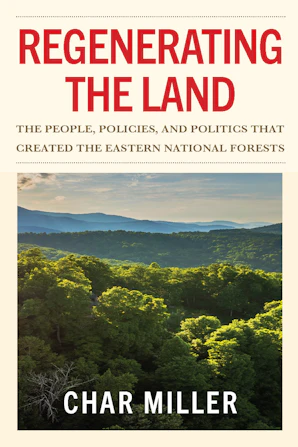
The Weeks Act and the People, Politics, and Policies that Created the Eastern National Forests
Over twenty million acres of conservation land–national forests, parks, and refuges-are now under federal protection under the 1911 Weeks Act. But their establishment, which allowed the federal government to purchase private land, was anything but simple: it required grassroots activism, political will, and legislative initiative to exert pressure on legislative bodies at the state and federal levels. It took long years of convincing both the public and politicians that these public lands were a primitive social good and that the economy depends upon the protection of the headwaters of rivers and watersheds.
These initial efforts created the Eastern National Forests, which extend westward to east Texas and south of the Ohio River, were created by the purchase or donation of largely cutover private land to the federal government. The “Eastern” land label distinguishes their origin stories from those located west of the Mississippi River. But like their western peers, their social and environmental values have been debated ever since, a mark of their contested nature.
At the forefront, the message stands that the eastern public lands are a century-old gift to present-day America. They constitute millions of acres that provide clean water and air, recreation, and flood protection, among other services, and they are a rich inheritance without which the nation would be poorer. Environmental historian Char Miller explores in depth the stark purpose public lands give to the nation, including real-world accounts accompanied by original photographs illustrate the importance of enforced protection.
CONTENTS
Introduction
Prologue: Rewilding the Northeast
INSTITUTIONAL VISIONS
1. French Lessons: Floyd P. Baker and the 1878 Paris Universal Exposition
2. Amateur Hour: Nathaniel H. Egleston and Professional Forestry in Gilded Age America
3. How William B. McKinley’s Pragmatism Saved the Public Lands
4. Neither Crooked nor Shady: The Weeks Act and the Virtue of Eastern Public Lands
Sidebar: Of Squirrels, Turkeys, and Clear-Cuts: The Monongahela National Forest
CHANGE AGENTS
5. Eminent Domain: Benjamin L. Wiggins
6. Reclamation Project: W. W. Ashe
7. Reforesting Mississippi: Raymond M. Conarro
8. “Mr. Forest Service”: Wilbur R. Mattoon
Sidebar: Blow Downs: Hurricanes, Climate Change, and Land Management
BATTLEGROUNDS
9. Impressing Nature: World War II and Southern Public Lands
10. In Wildness
11. Green Haze: Marijuana and Labor in the Appalachians
12. Maine Chance: Katahdin Woods and Waters National Monument
Sidebar: Staying Power: The Boundary Waters
FUTURE GROWTH
13. Mass Production: Cross-Laminated Timber’s Appeal
14. Tribal Lands, Tribal Sovereignty
Acknowledgments
Endnotes
Index
Regenerating the Land is the first book to deal comprehensively with federal conservation policy in the east; it is a broad overview focusing on the key players in conservation, the forest service, and the federal government more generally. I recommend it to anyone who hopes to understand federal conservation in Eastern part of the country right before and after the passage of the 1911 Weeks Act.
--Jason Newton, author of Cutover Capitalism: The Industrialization of the Northern Forest